Subtitle: Having skills in your repo does not mean the runtime will actually route by them. In practice, the model is far more influenced by the tool surface you expose, the live inventory a session can see, and whether your descriptions, schemas, and instructions line up.
This is not another “skills are important” article.
What I want to write down is something much more operational:
Writing a skill package does not guarantee that the runtime will behave like a skill-first system.
I learned that the hard way.
The request that exposed the gap was almost embarrassingly simple:
Score all the jobs that still do not have a score.
What I expected was:
- route to
job_scoring - stay on a score-only path
- do not fetch fresh jobs again
What actually happened looked much closer to an ingestion path. That was the moment I stopped treating skills, tool metadata, live inventory, and runtime tool selection as a single thing.
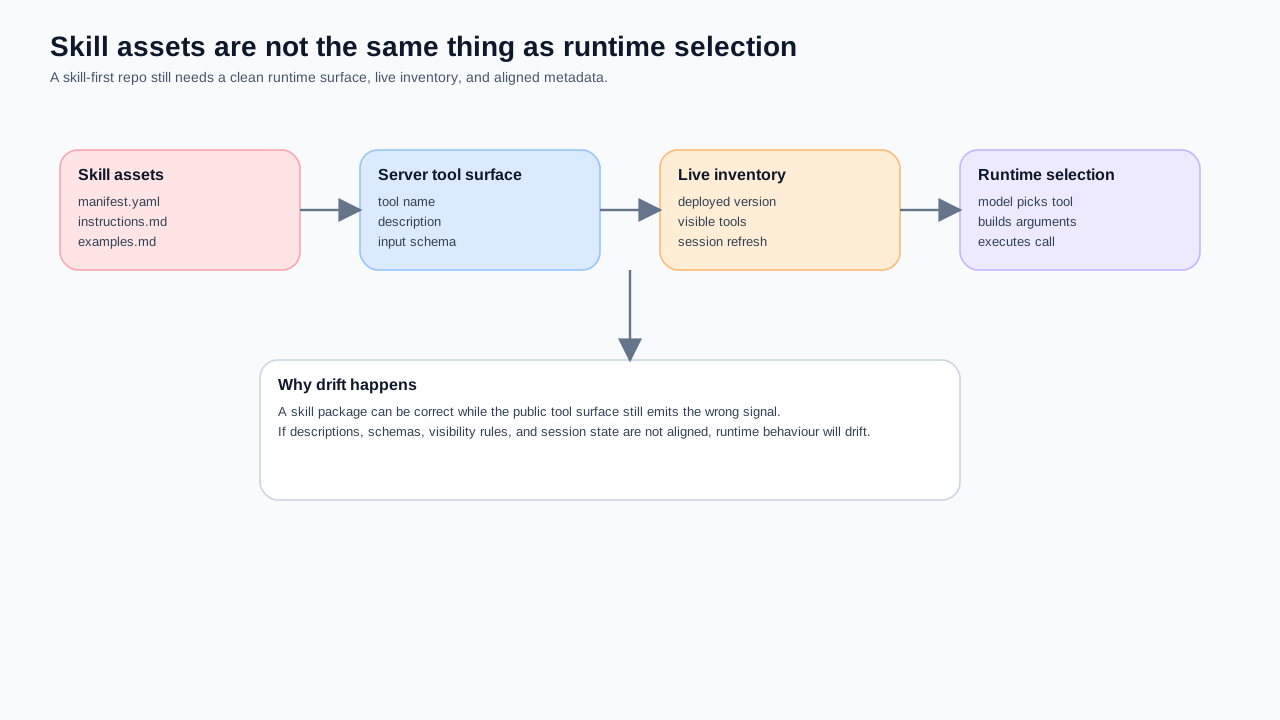
The short version: a skill is an asset layer, not an automatic routing gate
FastMCP does provide skills utilities. You can discover, download, and sync skills, and it can identify skill resources using URIs such as skill://{name}/SKILL.md. That matters. But what it describes is how skill assets are discovered and retrieved, not “the model will definitely read those skills first and obey them”.
At the protocol level, the first-class object the model actually gets to invoke is still the tool. MCP’s tools spec is very plain about this: tools are exposed with a unique name and schema metadata. OpenAI’s tool design guidance is equally plain: write concise, explicit descriptions, because the model chooses what to send based on your description.
So the mental model I trust now looks like this:
- skill: strategy asset, boundary asset, operating documentation
- tool: the runtime capability surface the model actually sees
- server instructions: the server-level operating manual
- provider / inventory: what this specific session can list and call right now
If those four layers are not aligned, your system may look skill-first on disk while behaving quite differently at runtime.
The problem only became clear after I split it into four layers
This is the debug map I use now.
Layer 1: skill assets in the repo
This is the GitHub layer:
manifest.yamlinstructions.mdexamples.mdeval-notes.md- router policy / fallback policy
This layer matters because it captures your design intent.
Layer 2: the tool surface actually exposed by the server
This is what the model really sees:
- tool name
- description / docstring
- input schema
- output shape
- which tools are listed at all
This is the interface the runtime touches every single turn.
Layer 3: live deployment and session inventory
This is the layer many teams forget:
- did you actually deploy the new code
- did the inventory refresh
- is the client session seeing the latest version
- are you still effectively serving old metadata
Layer 4: runtime tool selection
This is the final behaviour:
- which tools were listed
- which one looked most plausible for the request
- which schema seemed to fit the intent best
- whether server instructions actually helped
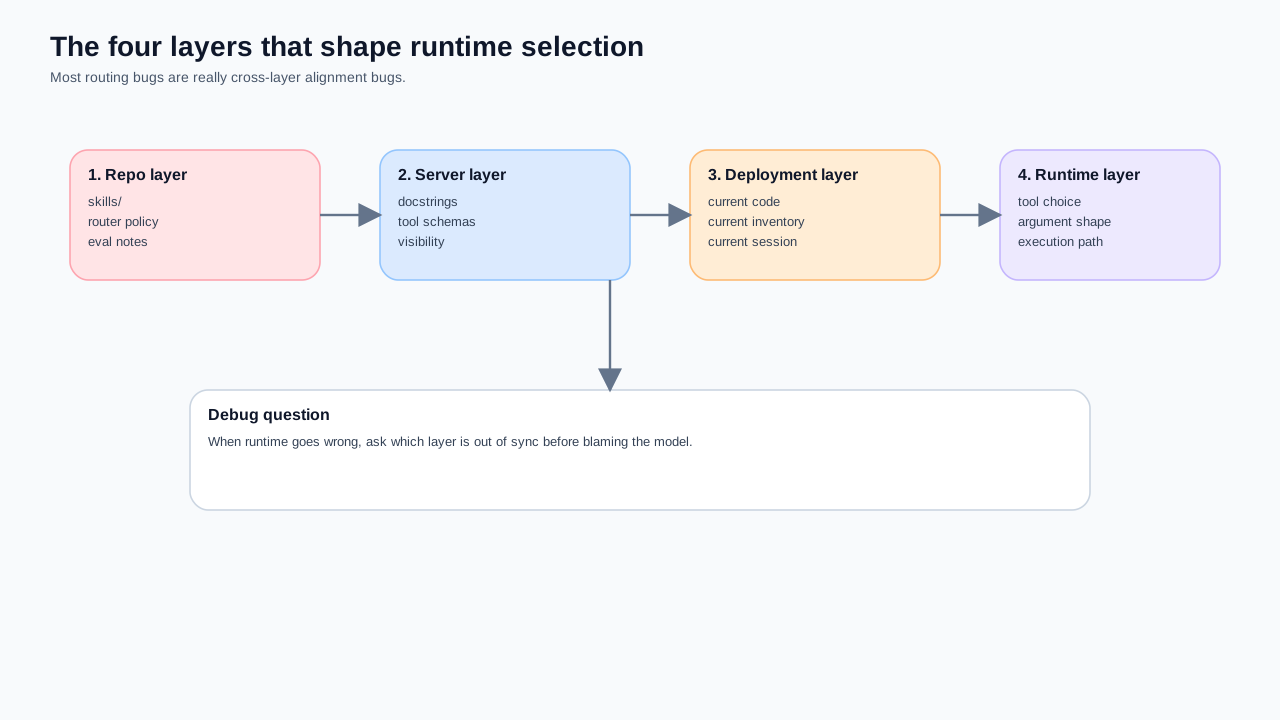
Once you separate those layers, a lot of “why is the model being stupid?” complaints turn into more useful engineering questions:
- was the skill boundary poorly written?
- or was the tool description sending the opposite signal?
- or was the session still stale?
- or were two tools simply too similar from the model’s point of view?
In practice, the decisive signal is often not the document you wrote for humans
OpenAI’s guidance for tools contains one sentence I would happily pin to a wall:
Write concise, explicit tool descriptions. The model chooses what to send based on your description.
That sounds like a writing tip. It is really a runtime systems tip.
If the model sees:
- a tool called
job_ingestion - a parameter called
force_rescore - and no clear description saying “this is not the score-only path”
then routing a backfill-scoring request into ingestion is not bizarre at all.
That is exactly why a skill file can be correct while the runtime still drifts.
A surface that tends to mislead
name: job_ingestion
input_schema:
  type: object
  properties:
    source_site:
      type: string
    days:
      type: integer
    page_from:
      type: integer
    page_to:
      type: integer
    force_rescore:
      type: boolean
From a model’s point of view, that looks like a very capable Swiss Army knife.
A healthier separation
name: job_scoring
public: true
allowed_backend_tools:
  - v2_tool_bulk_score_new_jobs
guardrails:
  - Do not fetch recent jobs in this skill.
  - Do not claim a fetch or refresh happened in this path.
That is essentially the spirit of the job_scoring manifest in your repo: score-only really means score-only. Once the manifest, server docstring, schema, and examples all say the same thing, runtime drift becomes much less likely.
A deterministic policy on disk is still not the same thing as a live routing gate
Your router/skill-selection-policy.md is already doing an important piece of architectural work:
- choose exactly one public skill first
- prefer
job_decision_supportoverjob_scoring - prefer
job_scoringoverjob_ingestion - keep
job_queryingas the broad read-oriented path - avoid automatic multi-skill chaining in v1
That is valuable because it defines how the system should think.
But I want to be very direct here:
Having that document does not mean the live runtime is enforcing it.
Why not? Because:
- the policy file is design intent
- runtime selection is the model reacting to the current visible tool surface
Unless you actually turn that policy into one or more of the following:
- visibility rules
- deterministic gating before exposure
- tool subsets through
allowed_tools - server-side filtering of which backend tools are reachable
then the policy remains closer to architecture guidance than an active traffic light.
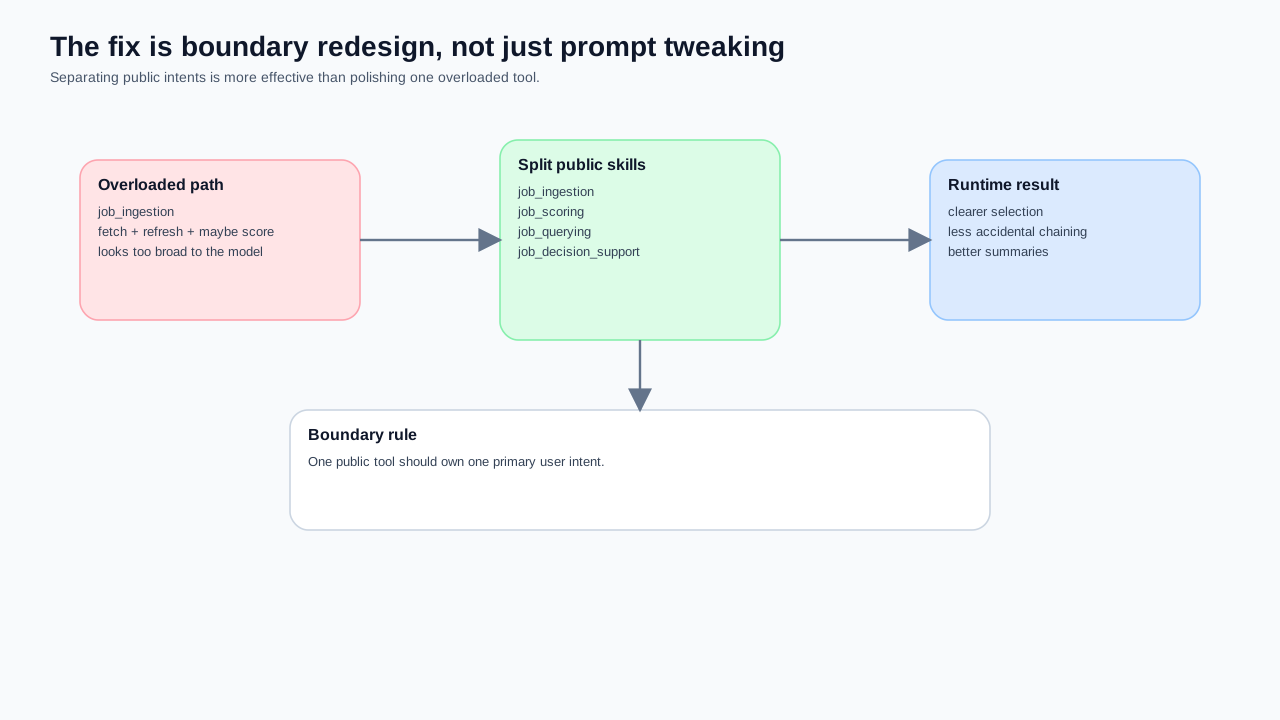
The real fix is usually not more prompt text. It is a cleaner capability boundary
This is the lesson I trust most now.
If a request keeps drifting into the wrong tool, do not start by blaming the model. Start by asking:
- Are two tools too similar from the model’s perspective?
- Did we leak low-level capability into the public surface?
- Are the manifest, description, schema, and examples out of sync?
The design moves that helped most
Move 1: one public tool, one primary intent
job_ingestionhandles refresh / fetchjob_scoringhandles score-only / backfilljob_queryinghandles shortlist / filter / rankjob_decision_supporthandles deep output for one job
Move 2: internal helpers should stay internal
A helper like resolve_job_reference can be critical without belonging on the public tool surface.
Move 3: change the manifest, docstring, schema, and examples together
If you only update one layer, the system still behaves like an instrument with one string out of tune.
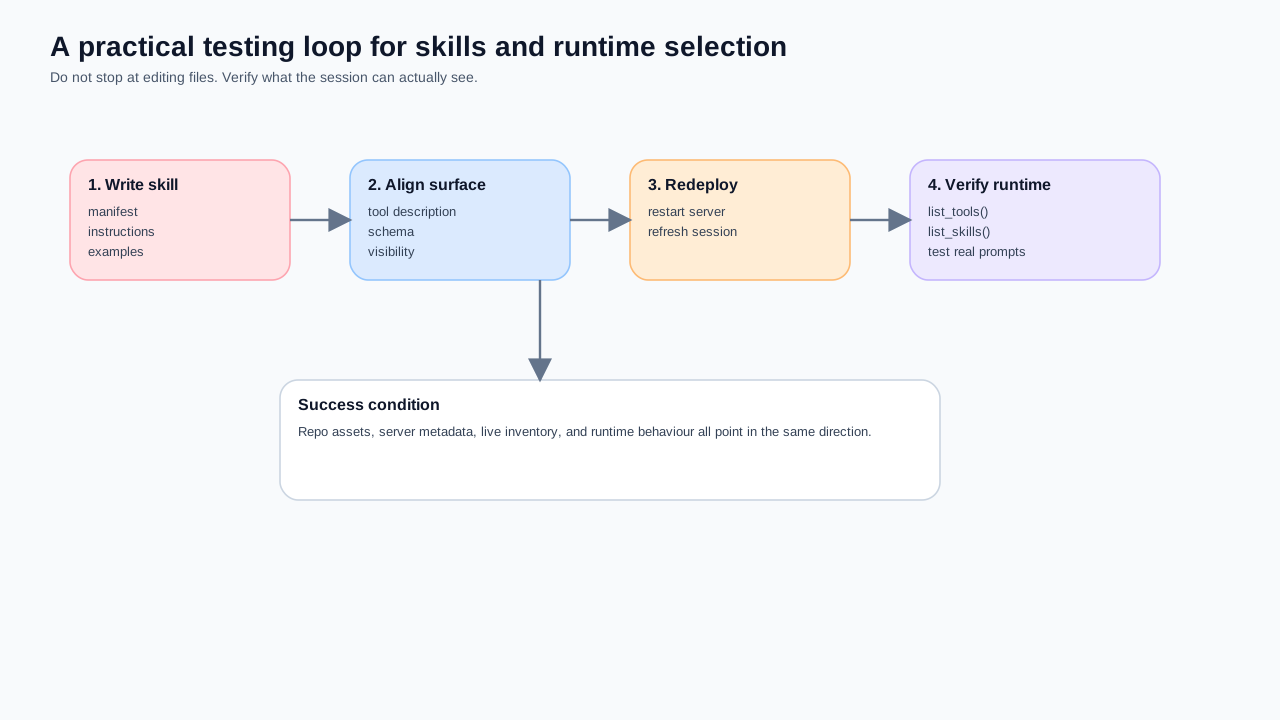
A more practical development loop
If you want a skill-based MCP server to behave like one in production, this is the workflow I now recommend.
Step 1: write the skill manifest before the server docstring
Be explicit about:
- the public skill name
- the user intent it owns
- the backend tools it may call
- what it must not do
- which missing context should fail hard
Step 2: align the server tool surface with that manifest
- the tool name should match the boundary
- the description should say what it does and does not do
- the schema should not keep ambiguous “maybe useful” parameters
- hidden helpers should remain hidden
Step 3: restart the server and reconnect the client
Do not assume the session is automatically seeing your new inventory.
Step 4: verify the inventory with a minimal client
I strongly recommend checking list_tools() and list_skills() before asking ChatGPT to act as an oracle.
from fastmcp import Client
from fastmcp.utilities.skills import list_skills

async with Client("https://your-server.example.com/mcp") as client:
    tools = await client.list_tools()
    skills = await list_skills(client)
    print([t.name for t in tools])
    print([s.name for s in skills])
Step 5: only then test natural language requests
And do not only test the happy path.
Test at least:
- score backfill
- refresh + score
- shortlist query
- single-job deep analysis
- mixed-intent requests
Server instructions are worth using, but not worth worshipping
The MCP maintainers have published a very good note on server instructions. I agree with the premise: server instructions are a kind of user manual for the model, and they can materially improve tool use.
But I would add one sentence of caution:
Server instructions help, but they do not replace a clean tool surface.
I treat them as:
- a navigation layer above skills
- a place to capture selection heuristics and prohibitions
- a way to explain the operating style of the server
not as a magic patch for messy public tools.
The checklist I keep now
Before I re-test routing after changing skills or server metadata, I run this list:
- does this request map to exactly one public tool?
- is the repo manifest aligned with the docstring?
- does the schema leak any misleading parameter?
- are internal helpers actually hidden?
- do the server instructions include the most important operating hints?
- was the live deployment restarted?
- was the client session refreshed?
- do
list_tools()andlist_skills()show the inventory I think I shipped?
The final sentence
The sentence I trust least now is this one:
The skill is written, so the model should know what to do.
No. At best, that means your strategy assets are in better shape.
Actual runtime behaviour still depends on:
- what the public tool surface looks like
- what inventory the current session can see
- what server instructions say
- which version the host has really loaded
If you want a skill-first MCP server to behave like one, do not stop at writing skills. Treat manifest design, docstrings, schemas, visibility rules, session refresh, and runtime tests as one engineering job.